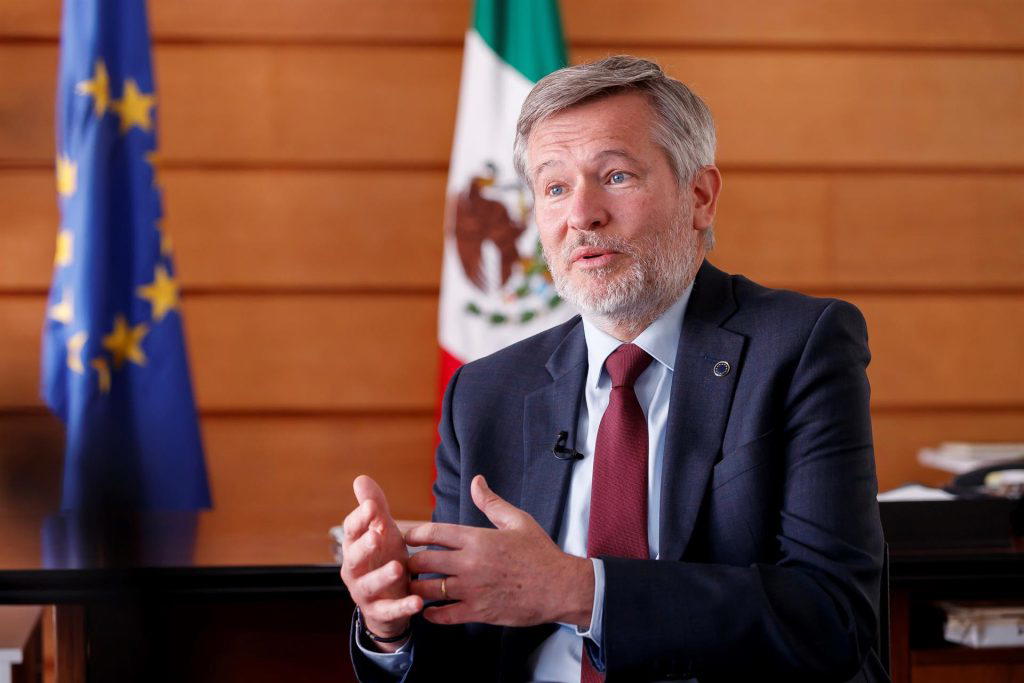
The European Union (EU) Ambassador to Nigeria and the Economic Community of West African States (ECOWAS), Gautier Mignot, has said Nigeria probably has the highest number of people living below the poverty threshold globally, describing poverty as one of the country’s biggest challenges.
The envoy spoke in Abuja over the weekend at the 2026 International Day for the Eradication of Poverty, where he called for sustained efforts by the Federal Government, development partners and other stakeholders to address the country’s poverty crisis.
“Today, Nigeria is probably the country in the world with the highest number of people living under the poverty threshold,” he said.
Mignot also disclosed that the European Union had committed nearly €45m in humanitarian assistance to Nigeria in 2026, particularly to support conflict-affected and crisis-prone areas.
He described poverty as a major concern for Nigeria’s international partners, stressing that it required urgent attention and sustained commitment in the years ahead.
Mignot cited figures indicating that 133 million Nigerians were living in multidimensional poverty in 2022, adding that estimates from different sources suggested the situation had worsened since then.
He said the EU’s humanitarian assistance was being provided through the European Civil Protection and Humanitarian Aid Operations, with particular attention to communities affected by conflict and other crises.
“Through the European Civil Protection and Humanitarian Aid Operations, ECO, the European Union has committed again this year almost 45 million euros for humanitarian assistance in Nigeria, particularly in conflict-affected and crisis-prone areas”.
According to him, the EU is working with the Nigerian government, humanitarian organisations, development partners and local communities to ensure that emergency assistance is linked to long-term resilience and sustainable solutions.
He explained that humanitarian interventions address immediate needs, while poverty reduction programmes focus on creating lasting pathways out of poverty.
Speaking on the theme of the event, United for Peace and Human Rights, Safe Homes for All, the ambassador said meaningful poverty reduction was impossible without peace, security, dignity and respect for human rights.
He added that households unable to meet their basic needs could hardly feel secure or fully enjoy their fundamental rights.
Mignot acknowledged the Federal Government’s efforts to tackle poverty through social investment programmes, targeted cash transfers, livelihood support and measures to strengthen social protection systems.
He listed the National Social Safety Net Programme, the Nigeria Community Action for Resilience and Economic Stimulus, and the Renewed Hope Social Protection Programme among the initiatives aimed at supporting vulnerable Nigerians.
He also highlighted the Household Prosperity and Empowerment Social Protection Project, supported through Nigeria’s partnership with the World Bank, saying the initiative was expected to improve assistance to vulnerable households and strengthen their resilience.
The envoy said the EU was complementing these efforts through its Supporting Sustainable Social Protection Systems in Nigeria programme, which works with government institutions and implementing partners, including UNICEF, GIZ, the International Labour Organisation, ActionAid and Oxfam.
He disclosed that the programme covered Abia, Benue, Oyo, Sokoto, Kebbi, Adamawa and Borno states.
According to him, the intervention focuses on strengthening social protection policies, expanding social registers to identify more poor and vulnerable households, and improving data systems for planning and resource allocation.
Mignot said multidimensional poverty assessments helped governments identify overlapping deprivations in education, healthcare, nutrition and living standards, enabling them to target interventions more effectively.
He added that the EU had supported the review of Nigeria’s National Social Protection Policy, as well as the development of state social protection policies and a Social Protection Bill.
The ambassador also called for stronger coordination between humanitarian assistance and long-term development programmes, noting that poor households were particularly vulnerable to emergencies, including severe acute malnutrition.
He welcomed the ongoing humanitarian transition, under which Nigerian authorities at all levels are expected to progressively assume greater responsibility for funding and coordinating humanitarian assistance.
Mignot commended the minister responsible for humanitarian affairs and poverty reduction, Bernard Doro, for his efforts and reaffirmed the EU’s commitment to supporting Nigeria’s poverty reduction drive.
He said tackling poverty sustainably required a coordinated, long-term approach involving government institutions, civil society, local communities and international development partners.
“Humanitarian needs cannot wait, and poverty either,” he said, urging stakeholders to make the fight against poverty a year-round priority.