
Ekiti APC: Elite Vs The People
I have always been fascinated by Ekiti and Ondo states for some strange reasons. Those states have bred some prominent persons who are stubborn to their principles and uncompromising to a fault. When I remember the late Chief Gani Fawehinmi, who hailed from Ondo State, and former governor of Ekiti State, Ayodele Fayose, they evoke in my mind the uncompromising fidelity to self-principle.
The second reason stemmed from the popular belief that almost everyone is educated in those states! I have heard the joke that if you go hunting in the forests of those two states, you’re sure to catch a professor!
In my opinion, these are admirable qualities in any human society, including in ours, where loyalty and unwavering dedication to noble principles have become scarce commodities in the integrity market.
This is why I’m bewildered by the unfolding drama over the All Progressive Congress governorship primary in Ekiti State, where Governor Biodun Oyebanji is allegedly allergic to going through the party
primary.
Oyebanji was on Monday, 27 October 2025, declared the consensus governorship candidate of the party in next year’s off-cycle election in the state by a panel chaired by Kogi State governor, Ahmed Usman Ododo.
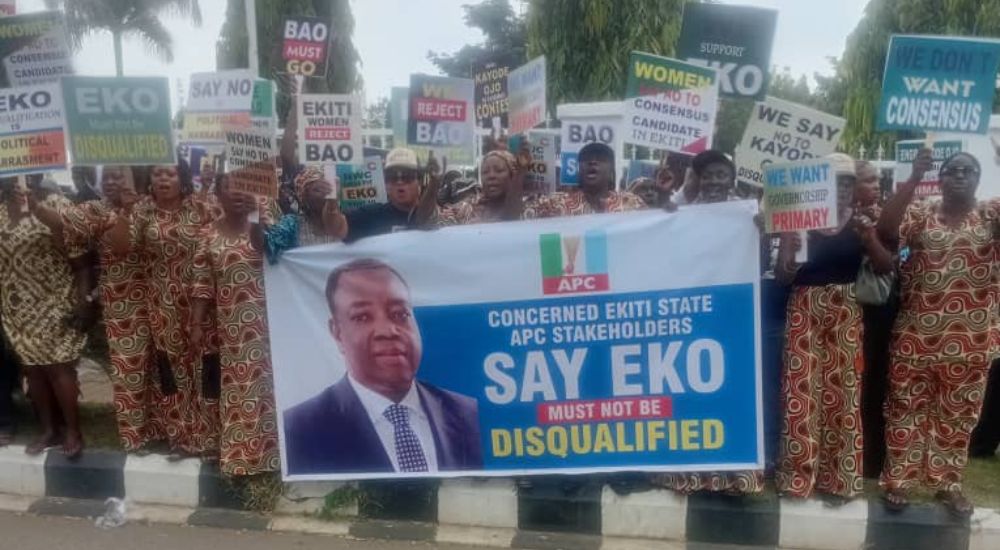
Before the day, angry women from Ekiti State stormed the APC National Secretariat with placards, asking the party to hold a governorship primary instead of having a consensus candidate. The woman said Governor Oyebanji was a failure and claimed that he did not want a primary because he was afraid that Dr Kayode Ojo would defeat him.
The National Working Committee of the party had at its 179th meeting three weeks ago disqualified Dr Kayode Ojo and one other aspirant without giving any reason for the disqualification. Dr Kayode Ojo is believed to be the man to beat for the governorship ticket of the party due to his family pedigree and his personal accomplishments.
The party later said that his disqualification was predicated on the fact that his filings did not conform to the provisions of the APC constitution and the Electoral Act. Subsequently, the party, in a letter dated 13th October, 2025 and jointly signed by the National Chairman, Prof. Nentawe Yilwatda, and Secretary, Senator Ajibola Basiru, informed the Independent National Electoral Commission (INEC) of the plan of the party to change the mode of primary from Direct to Consensus.
Dr Kayode Ojo is the son of Chief Joshua Akanbi Ojo, a renowned businessman and philanthropist who touched the lives of many Ekiti indigenes during his lifetime. Dr Kayode Ojo obviously inherited his father’s generosity and philanthropic disposition – traits which have made him popular with the ordinary people of the state.
A trained engineer, successful entrepreneur and international investor, Dr Kayode’s governorship campaign has been centred around wealth creation and equitable distribution to improve the standard of living of the people.
Fondly called Eko by admirers, his campaign certainly resonated with the people, perhaps sending signals to the incumbent governor that the APC ticket may not be guaranteed for him if he allowed a primary election to take place.
Some party stalwarts told this writer that Oyebanji did not want to contest in any primary for fear of losing to Ojo, who is believed to be more popular in the state.
The masses of Ekiti State seem to believe that Governor Oyebanji does not deserve a second term based on his record of achievements. The women who protested at the APC secretariat in Abuja last week said the governor’s record in every sector and facet of life in the state was poor.
“No good roads in Ekiti, no potable water, no healthcare and no light,” Ms Abereniola Mercy, one of the leaders of the women protesters, had told journalists. They had called on the party leadership to allow Dr Kayode Ojo to contest the primary and termed his disqualification as “political intimidation”.
But while the women claimed the masses are not in love with Governor Oyebanji, political leaders in the state seem comfortable with him.
Ex-governor Fayose, while speaking on a recent episode of Channels Television’s Politics Today, said Gov. Oyebanji “is doing well” in the state and revealed that all the leaders in the state across party lines had adopted him for a second term.
Is the case in Ekiti State that of the people vs the elite? Fayose, a man who became governor largely due to his connection with people, was silent on whether the people would like Oyebanji to continue in office or not. Instead, he emphasised the point that all the leaders of the state have agreed to support Oyebanji’s re-election next year.
But now that APC appears to have deliberately denied some persons the opportunity to contest its governorship primary in the state and seems unable to manage the fallout because some of its men have been compromised, it will make the party vulnerable going into the election.
It may push aggrieved aspirants to seek other platforms to challenge the incumbent in the governorship election if they feel they’re popular enough to win. If that happens, Oyebanji is going to fight with his hands and would have to deploy all his incumbency advantages to overcome the odds.
In Ekiti State, the people don’t suffer fools gladly! If they reject you, it may be that the gods have also rejected you. The Ekiti women who protested in Abuja against Oyebanji were not the usual hired crowd. They came wearing uniformed dress. There was anger in their speeches and scorn in their eyes. Those women said Ekiti people have rejected Oyebanji and urged the party to field “Eko” as the governorship candidate in next May’s election.
But the leadership of the APC did not listen to them. No one from the party secretariat came out to address them. The women came to Abuja with the hope of saving the ship. But the sailors were adamant. They returned to Ekiti with frustration at a system that shuts out their voices.
The coming days will show who was right – the people or the party?
– Tajudeen Suleiman is an Abuja-based journalist. Email: tajudeensuleiman64@gmail.com
Ekiti APC: Elite Vs The People is first published on The Whistler Newspaper